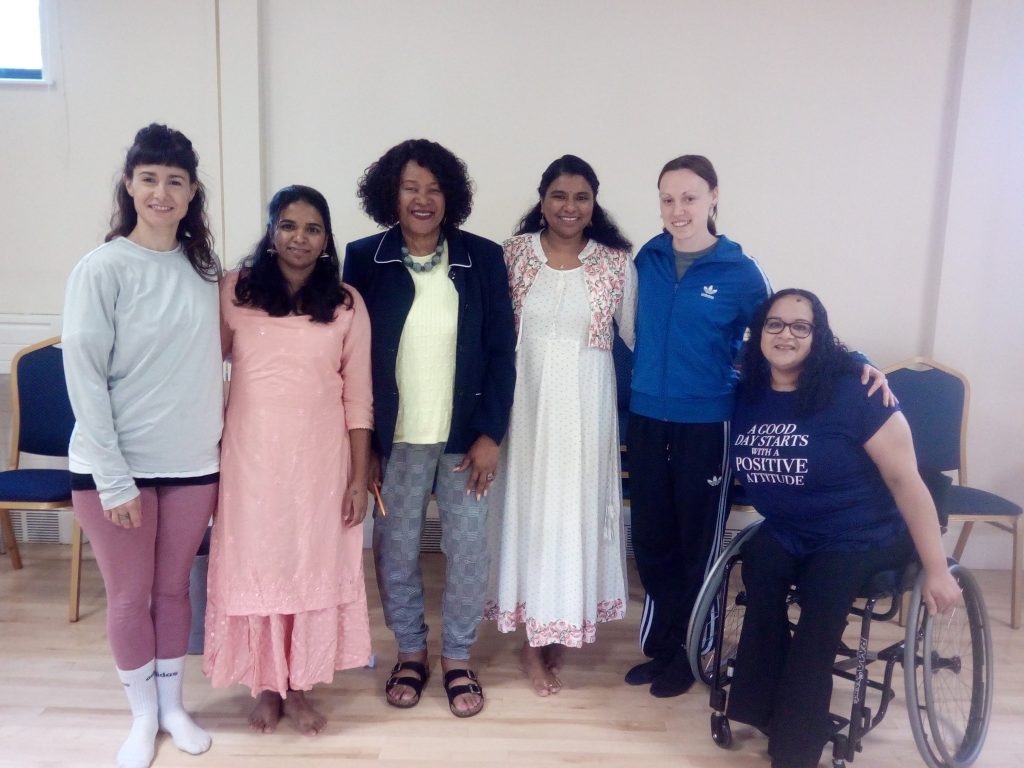
Amy started dancing at the age of two at Jenny Brennan School of Dance, before being awarded a full scholarship to train at Elmhurst Ballet School, in Birmingham, from the age of 12 onwards. Whilst training there she had the opportunity to work alongside guest choreographers including Ruth Brill, Paul James Rooney and Adam Rutherford. She also had the opportunity to create dance pieces for the yearly choreographic competitions.
Amy went on to train at Rambert School of Ballet and Contemporary Dance achieving a BA Hons in 2020. During her time at Rambert, she had the opportunity to work with choreographers such as Darren Ellis and Thick and Tight and performed Christopher Bruce’s piece called ‘Stream’. Throughout all of her training, she was involved in a number of different choreographic platforms and also worked with local year 10 GCSE students choreographing a piece for the ‘Aspire’ project.
Amy has also been a member of Transitions Dance Company touring around the UK, performing works choreographed by Didy Veldman, Rahel Vonmoos and Dog Kennel Hill Project. She also gained a MA in Dance Performance.
Amy is currently a freelance dance artist within Stoke-On-Trent. She has recently worked with Restoke, performing in the Lotus Eaters, and is continuing to help others with episode 5 of the Odyssey. She is also really looking forward to working with New Vic Theatre performing in their Christmas show- The Nutcracker in 2023-2024. In the future, she also endeavours to create her own work to express her own artistic voice.
Amy has taught and explored movement with a range of ages and backgrounds. She teaches in private dance schools from the ages of 3 upwards. As well as leading dance sessions for over 60s within the community setting. Additionally, Amy is a regular teacher for Staffordshire Youth Ballet- an associate programme for young aspiring dancers. She also works at the YMCA in Hanley, leading movement-based sessions for disabled and neurodivergent children and young people. Amy is really interested in how dance can be utilised to support well-being, specifically, in how we can tell stories and express ourselves through movement. She is really grateful and excited to be working with FRONTLINEdance as a youth ambassador and associate dance artist, to share her lived experience, and her love for movement with others.
FRONTLINEdance, as an Arts Council England National Portfolio Organisation (NPO), 2023-2026, is recruiting for Board Members and a new Chair of the Board. As a not-for-profit company ltd by guarantee (no shareholders), voluntary board members will support growth and stability to ensure FRONTLINEdance remain a permanent fixture in the arts and disability ecology of the West Midlands and Nationally.
Deadline for expressions of interest: 5pm, Monday 11th September 2023
Find out more about FRONTLINEdance, by clicking the link.
We are keen to ensure that the new Chair and Board members represent who we are as an artist-led company. A dance company where d/DEAF, disabled, neurodiverse, and those with long-term health conditions are at the core of the organisation as leaders, dancers, artists, participants, and audiences. We are also committed to ensure underrepresented groups and communities with whom we frequently work, are represented on our Board. As such, we are keen to receive applications from:
people who represent groups from lower socio-economic backgrounds, from the Global Majority, who are d/DEAF, disabled, neurodiverse, and/or have long-term health conditions
those who have strategic experience of Stoke-on-Trent and the surrounding area
single parents and parents of d/DEAF, disabled, neurodiverse children including children who have a health condition.
THE BOARDS PURPOSE: to support FRONTLINEdance to deliver with quality an ambitious activity plan that embeds the Arts Council England’s shared Investment Principles and #Let’s Create strategy. To advocate for and introduce to potential supporters, partners, investors; to advocate for access and inclusion widely, be objective with the ability to scrutinise and question FRONTLINEdance’s decisions, planning and delivery, to advise the organisation and support in its strategic aims for the long-term organisation development and sustainability.
Being based in Stoke-on-Trent means that our work is positioned to the Levelling-up Agenda, and therefore the Board should also be strong advocates for programming and connecting to those who are harder to reach (due to geographical, social or economic limitations).
SKILLS, KNOWLEDE, COMMITMENT TO:
Inclusion and access being embedded and at the centre of all we do and then advocate this externally. The social model of disability is central to all our thinking
Ensuring the board can be a place where d/DEAF, disabled and neurodivergent people can lead, develop and thrive with equity.
Supporting the contemporary dance, arts and disability ecology
Sector development; carer pathways where barriers are removed for those where academic attainment is not possible.
Arts Council England’s Investment Principles and #Let’s Create Strategy
Sound business models for the arts and not-for-profit sector
Sector development; giving others the tools, skills and confidence to make their practices accessible and fully inclusive
Ability to objectively scrutinise and hold the company to account
Supporting FRONTLINEdance staff, to help achieve the aims of the organisation.
Fostering relations with potential clients and potential funders/donors.
Ensuring adherence and compliance around key policies to e.g. Equality and Diversity, Health & Safety and in all decisions and discussions of the Board.
Stimulating excellent, well-rounded and carefully considered strategic decision-making.
ADDITIONAL FOR THE CHAIR POSITION:
Have the ability to Chair meetings where all voices are heard displaying good time management.
Create a strong, profitable and fulfilling working relationship with the board and FRONTLINEdance staff.
Liaise regularly with the treasurer to maintain a clear grasp of FRONTLINEdance financial position and to ensure full and timely financial transparency and information disclosure to the board.
Approve the annual cycle of the board meetings, meeting agendas, chair and facilitate meetings, monitor decisions taken at meetings and ensure they are implemented.
Support and contribute to strategic plans and conduct regular reviews of long-term strategic aims of FRONTLINEdance.
Lead and mentor other board members to fulfil their responsibilities and enable access to training/coaching/information to enhance the overall contribution of the board.
Annually review the board structure, role, staff relationships and ensure implementation of agreed changes/developments are carried out.
Encourage team working among board members and encourage them to identify and recruit new trustees as required.
Represent FRONTLINEdance as a spokesperson at appropriate events, meetings or functions.
Act as final stage adjudicator for disciplinary and grievance procedures if required.
Facilitate change and address conflict within the board of Trustees, within FRONTLINEdance and liaise with the appropriate FRONTLINEdance staff to achieve this.
BENEFITS OF JOINING OUR BOARD:
Your professional networks will be enhanced with opportunities for skills development and career progression.
Develop your sound judgement and interpersonal skills.
Opportunity to lead and work with d/DEAF, disabled and neurodivergent professionals.’
Make a difference to the local community! Your role helps ensure that FRONTLINEdance remain viable and sustainable.
Support community engagement and community cohesion.
Develop problem-solving, analytic skills and versatility.
You will play a part in ensuring Stoke-on-Trent and North Staffordshire is a place where d/DEAF, disabled people, neurodivergent, and those with long term health conditions can thrive.
TIME COMMITMENT AND TERMS
2-3 years, with staggered replacement
You are required to fully participate in quarterly board meetings usually held via zoom: 20th September 2023, 20th December 2023, 20th March 2024 & 19th June 2024
Communication via email and Whatsapp will be necessary.
Attend at least one performance or event per year. More is desirable but optional.
Check emails and respond in a timely manner.
Ensure that FRONTLINEdance pursues its objects (purposes) as defined in its governing document and other relevant legislation/regulations.
View our newsletter here – Find out how you can join us at The Big Feast 2023 plus information about our Connected Communities Summer Celebration Project!
Connected Communities is our Summer Celebration Project, where we celebrate who we are, engage with new participants and audiences, and explore something new each year. It’s about collective joy, meeting new people, learning new things and achieving together!
Throughout the project, FRONTLINEdance will celebrate the Stoke-on-Trent community’s rich culture, heritage and green spaces, by creating a cross-art form celebration event of dance, music, song, costume, spoken word, and creative writing; inspired by and co-created with the local diverse community in which we’re based.
It will be the result of a community participatory programme to encourage different communities to come together to celebrate and share connections, and traditions: Click on this link to find out how you can join us! This is the link to the timetable.
In a spirit of joy and friendship, this project will culminate and be celebrated over the 3 days:
Appetite’s Big Feast on 26th August: snippets and tasters of the work created will be performed in various outside areas of Hanley – Stoke on Trents’ City Centre between 11am and 4pm. We’ll also join the Windrush75 parade.
Tunstall Park on 9th September: A FREE performance and participatory arts event where the audience will be led around different areas of the park where they will be met by a multi-cultural cast of musicians, singers, dancers, and poets. Poems and creative writing will be attached to trees and benches, and a treasure trail will be created. Workshops will take place in the flora hall throughout the day as well as on the grass areas and under the trees.
Inside Social Club type of venue TBC on 10th September: audiences, staff, volunteers and the cast will come together to celebrate what we have achieved with food, conversations and dancing. Pop-up performances will take place throughout the event by the cast, conversation tasks to get people talking to each other and share, along with playing traditional games from different cultures suggested by the cast.
We’ll positively impact the local community, address inequalities, and improve community cohesion. Participants will form new friendships, and understanding, experience collective enjoyment and achievement, celebrate things that are important to them, share them, and engage in the arts and new people for the first time.
The physicality of dance, the creativity of writing, music and song as a fabric of community, the culture marker of costume design, and artwork for promotion, will result in a multi-faceted creative artistic experience full of benefits to everyone who experiences it!
Individuals’ voices, culture and lives will be celebrated with equity and enjoyment.
Connecting Communities: Participants Sessions
IMPORTANT: Due to the nature of the project resulting in performance, the timetable is subject to change. We’ll let you know at least one week in advance of changes. FRONTLINEdance is also waiting for confirmation on the lead musician so that is why there is a (?). You are more than welcome to attend all the sessions even if you are not performing with us. Where it states, ‘Rehearsal for performances’ you can still attend as a volunteer? We’ll have several volunteer jobs for you to do. You can attend as many sessions as you like. Each session will be different. Like all our sessions, all our summer project sessions will be inclusive and you can take part sitting. If you require a BSL interpreter to be at any of the sessions, please let us know as soon as possible.
All sessions are intergenerational, therefore approximately 5-year-olds to 85-year-olds will be enjoying and achieving together. For Safeguarding, those under 13 years old will need to be accompanied by a parent/carer/older friend or family member. Remember family and friends can join us too.
Lastly, a reminder that we will not be providing any medical or personal care. Therefore, if this is something that you require then you will need to attend with a person who supports you with this.
Thanks for your patience and support, Rachael and the FRONTLINEdance Team.
Today is Brian’s first day as our Company Development Manager and coincidently it falls on Deaf Awareness Week.
We asked Brian some questions:
1.Tell us about yourself.
Answer:Hi, I am Brian Kokoruwe, former Great Britain international athlete, Manager of GB and Assistant European Deaf Sports Athletics Technical Director. I still enjoy sports and fitness training. I have a wide range of work experience in the private, public and self-employment fields. I am excited to be part of FRONTLINEdance company, and I am looking forward to being part of the team that brings fascinating and accessible performances to the local communities. I have written 3 books about the barriers I faced from birth, becoming deafened through meningitis and through the early part of my education.
2. What are you most looking forward to whilst working with us?
Answer: I am excited to start my new employment venture with FRONTLINEdance as Company Development Manager. I am looking forward to working with my FRONTLINEdance colleagues and seeing FRONTLINEdance company getting more exposures across the country, putting out more performances and demonstrating that there should be no barriers for Deaf/Disabled/Neurodivergent people from taking part in theatre performances and therefore showcasing examples of inclusivity at various fields and life spectrums.
3. Deaf Awareness Week 2023 will take place from the 2nd to the 8th of May, and this year the theme is deaf inclusion. This year’s theme highlights how hearing loss impacts daily life and how others can help support deaf people. Why is deaf inclusion important? What can others do to support deaf people?
Answer: I am always keen to participate or promote deaf awareness during Deaf Awareness Week because deafness is an invisible disability and so many people/organisations tend to forget the needs of deaf people or simply make wrong assumptions that all deaf people have the same requirements. This is completely WRONG. Deaf people have various support requirements. The key thing is to communicate with the individual deaf person what their requirements areand then one can make reasonable adjustment to provide for the needs of individual deaf person rather than make incorrect assumptions and therefore provide wrong support. Deaf inclusion is very important because no one should be excluded on the ground of deafness. For Deaf Awareness Week, I would like organisations and individuals to please learn more about deafness through Deaf Awareness Courses, learn basic British Sign Language and make more of an effort to communicate with deaf people. Do you know the differences between deaf and Deaf? Learn about this during Deaf Awareness Week through having a go at our quizzes.
4. Anything else that you would like to add?
Answer:As part of Deaf Awareness Week 2023, we are going to run daily quizzes via FRONTLINEdance’s social media – FRONTLINEdance1Answers will be shared the following day.
We welcome you to share your answers each day from 2nd May!
Read/Listen to the article written by Caroline Butterwick following a conversation she had with our Artistic Director, Rachael Lines and dancers Matt Byatt and David Jowett.
‘Disabled children need to know it is an option’: co-creating the future of dance’
FRONTLINEdance works in communities to remove barriers for disabled people and those with long-term health conditions – and there’s no distinction between teacher and learner
‘There’s a richness in everybody’s life’ … Amal Hope, Vicci Riley, Charlotte Arnold and Helen Yeomans in a Frontline performance. Photograph: Dominic Erik Davies
Several adults form a circle in a community hall, swerving their bodies and linking arms. One spirals around a chair, using it as part of their movement. This is Breakthrou’dance, a group in Stoke-on-Trent for disabled participants. They come together each week to do what Frontlinedance founder Rachael Lines calls “dancing with”, rather than the traditional model of following an instructor.
Co-creation – making work with people, rather than telling them what to do – is a concept many arts organisations aim for. Lines talks through a recent project that involved working with members of local disability groups. “We had conversations about different themes, challenges, things they would like to share, or to tell people about. We looked at the social model of disability, and how we could use that.”
The group explored movement together that emerged from the discussion, with Lines asking how the body might feel with different emotions. “They would generate the movement, and then I would develop that, keeping all the key themes and finding commonalities, what visually looked exciting,” says Lines, who co-founded Frontlinedance in 2001.
In developing one performance, visually impaired dancers shared how they get pushed in crowds, inspiring the choreography. “We created those barriers, the hustle and bustle, moving together with dropping, falling and catching, and knocking,” Lines explains. The raw experience of what it’s like to navigate public space as a blind person is reflected in those movements in a way that is visually interesting while highlighting something many don’t realise.
Co-creating brings together different viewpoints – “there’s a richness in everybody’s life,” says Lines. “Historically, disabled people have had less of a voice, and fewer opportunities to be makers, dancers and choreographers or even audience members.”
Rachael Lines, in orange top, with the Breakthrou’dance group. Photograph: Natalie Willatt
Lines trained at the Northern School of Contemporary Dance in Leeds. In the mid-90s, during her studies, she watched the integrated dance company Candoco perform: “It was so fresh, nobody else was doing it.” Lines had a back injury, and she experiences hemiplegic migraines triggered by light, which led her to decide against making a career performing on stage and helped her see the challenges disabled dancers face.
She resolved to form an artist-led contemporary dance company that placed disabled people and those with long-term health conditions at the centre. She now runs projects everywhere from neurology wards to Stoke’s Potteries Museum, and in ongoing groups such as Breakthrou’dance, involving those who traditionally feel out of place in dance.
Frontline also works with local arts organisations, with disabled people advising on everything from audio description to physical accessibility. It’s helped create a community, with people coming together to attend shows and arts events they once felt excluded from.
Dancers from Frontline recently took part in The Pig Walk, a parade in the Stoke town of Longton. Dancers David and Matt tell me how being part of a shared experience – the walk attracted thousands of people – was empowering. “Proud,” David says, communicating through speech and Makaton.
Matt has been involved with Frontline for 21 years, starting as a dancer, receiving training which led to him supporting classes as a workshop assistant and creative enabler. “I’ve come a long way,” he says. “I love the work I do. I was proud when I got to paid status, that was a big achievement.”
Many dance training schemes require a level of academic attainment that excludes a lot of people, and Frontline is starting a new training programme that it hopes to launch next year, to address this. “We’re seeing Paralympians on Strictly, which is good,” says Lines. “But there’s still the barrier of it being seen as a possibility. We need more disabled children and young adults to see and know it can be an option for them.”
There are barriers to disabled people taking part in dance, from inaccessible rehearsal and performance spaces to attitudes about what disabled dancers are capable of. There are also challenges in meaningful co-creation: some dancers need concrete instructions, while others prefer the freedom to move how they want. Lines says tailoring to individuals and not making assumptions helps.
“The work we’re doing is breaking down negative preconceptions people have. And I think that’s a positive thing, even though it’s a frustrating thing, because, well, why don’t you think someone with a disability can achieve or be brilliant?” says Lines. It’s an ongoing question for disabled artists: how to highlight disabled voices and challenge negative ideas, without falling into tropes of “overcoming”.
Lines has seen the company’s impact on both dancers and audiences. When they perform in hospitals to people stuck in bed, “they say we made them feel like they were alive and part of the world, which is brilliant – I really can’t ask for more.”